
🥺👉💔 My mother-in-law gave my 7-year-old daughter a phone every day just to keep her quiet. Soon, my little girl started seeing double, forgetting words, and suddenly freezing without responding. When we rushed her to the hospital, the doctor opened the phone and discovered something that made me realize I had never truly known my mother-in-law at all… 😱‼️
When my husband’s mother, 64-year-old Margaret, offered to take care of our seven-year-old daughter, Emily, while I was at work, I thought we couldn’t have found a better solution.
My husband, James, frequently traveled for business, and I worked as a nurse at a hospital. Sometimes, I had to be away from home for twelve hours at a time.
Margaret had been living with us since her husband passed away. She always said that her granddaughter was the only joy left in her life.
At first, everything seemed wonderful.
But before long, I noticed something strange.
Every time I came home from work, I found Emily sitting in exactly the same position on the couch.
She would be holding a phone, completely absorbed in the screen, while our elderly dog, Buddy, rested his head beside her.
One evening, I asked my mother-in-law why Emily spent the entire day on her phone.
Margaret didn’t even look up.
“Because she sits quietly that way. I can get my things done. Do you have any idea how difficult it is to chase after a child at my age?”
Her words bothered me, but I decided not to argue.
A few weeks later, my daughter began to change.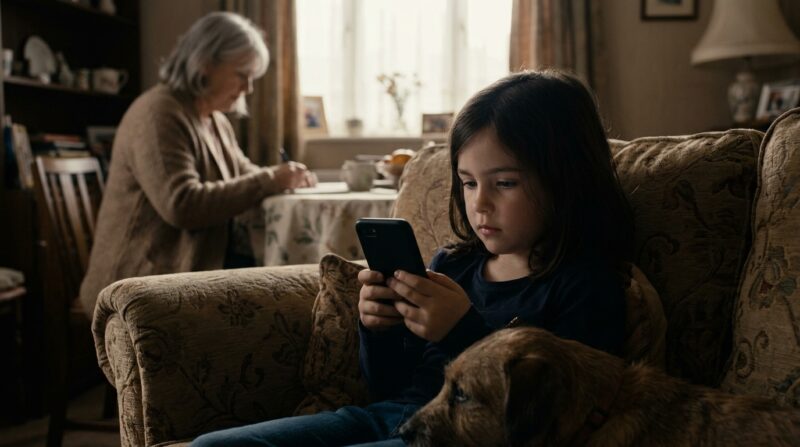
First, she stopped playing outside.
Then she lost interest in her favorite books.
She started waking up frequently during the night, and dark circles appeared beneath her eyes.
One afternoon, I noticed her holding the phone unusually close to her face.
“Emily, sweetheart, why are you looking at it like that?”
“Mommy, sometimes the letters turn into two.”
My heart tightened.
The following day, her teacher called.
She told me that Emily had suddenly become completely still several times during class, staring into space without responding when someone called her name.
Even more frightening, my daughter had begun forgetting ordinary words.
I came home furious and told Margaret she was no longer allowed to give Emily the phone.
My mother-in-law turned pale.
“Sarah, there are things you don’t know.”
“What don’t I know? That you’ve been leaving my daughter in front of a screen all day because you don’t want her bothering you?”
She said nothing.
That night, Emily suddenly lost her balance and collapsed in the hallway.
We rushed her to the hospital.
Dr. Roberts examined her carefully and asked several questions.
Then he requested the phone Emily had been using every day.
When he opened the most recently used application, his expression changed dramatically.
He stared at the screen in silence for several seconds before hurriedly leaving the room.
Moments later, he returned with another doctor.
“Mrs. Sarah, we need to perform additional tests immediately. Your daughter’s condition may be much more serious than you realize.”
The rest of the story is in the comments 👇‼️
I burst into tears.
“What is happening to my little girl?”
The doctor looked at me, then at Margaret, who stood near the doorway.
“The question is why nobody acted on these warning signs sooner.”
My mother-in-law covered her face and began crying.
Her confession revealed a secret she’d been hiding for months.
In the hospital hallway, Margaret sank into a chair.
“Sarah, I didn’t know it was this serious,” she whispered.
“What didn’t you know? That a seven-year-old shouldn’t spend every waking hour staring at a phone?”
She lowered her head.
“At first, I gave Emily the phone so I could cook, clean, or simply rest. She stayed quiet, and I convinced myself everything was fine.”
Then her voice broke.
“One day, she said the room was spinning. Later, she complained about headaches. I thought it was too much screen time. I took the phone away, but she cried.”
“And you gave it back?”
“Yes.”
I turned away, furious.
Dr. Roberts returned and explained that Emily’s vision problems, balance difficulties, and episodes of unresponsiveness couldn’t simply be blamed on phone use.
She needed a brain MRI.
“Are you saying she might have a tumor?” I asked.
“It’s too early to know.”
Those hours felt endless.
James arrived from his business trip and found me clutching Emily’s little jacket.
When he learned what had happened, he confronted his mother.
“Mom, why didn’t you tell us?”
Margaret silently reached into her handbag and removed a small notebook.
“I wanted to. But I was afraid.”
Inside were dated observations.
Emily complained of headaches.
Emily said the television picture looked doubled.
Emily struggled on the stairs.
Emily didn’t respond when I called her name.
I stared at her.
“You knew all this?”
“I thought she was tired. Then I got scared you’d never trust me with her again. I kept postponing the conversation.”
Her silence had put Emily at risk.
But the notebook contained another surprise.
Beside several dates, Margaret had written numbers indicating how long Emily’s strange episodes lasted.
“Sometimes she saw flashing lights,” Margaret explained. “I started timing the episodes. Then I recorded them.”
Suddenly, I understood what the doctor had discovered on the phone.
The last opened application wasn’t a game.
It contained videos of Emily’s frightening symptoms.
In one recording, my daughter sat on the couch beside Buddy.
Without warning, she froze, staring blankly ahead.
Buddy immediately raised his head and anxiously nudged her hand.
I covered my mouth.
I’d seen Emily on that couch countless times, but never like this.
The next morning, the MRI results arrived.
Dr. Roberts explained that doctors had discovered a small mass in Emily’s brain, possibly responsible for her symptoms.
Further examinations would determine the treatment.
“Was it caused by the phone?” I whispered.
“No,” he answered. “There’s no evidence connecting this mass to phone use. Excessive screen time can cause eye strain and sleep difficulties, but it doesn’t explain what we’ve found.”
Margaret began sobbing.
The doctor added that her recordings and detailed notes had helped the medical team recognize the seriousness of Emily’s episodes.
For the first time, I saw my mother-in-law differently.
She’d made terrible mistakes, especially by keeping everything secret.
Yet she’d also been frightened enough to document every symptom, desperately trying to understand what was happening.
After additional tests, specialists recommended surgery because of the mass’s location.
I barely left Emily’s bedside.
Neither did Margaret.
One evening, she approached me while Emily slept.
“Sarah, I’m not asking for forgiveness. I should have told you immediately. I just want my granddaughter to live.”
I swallowed my tears.
“I can’t forget what you hid from us. But I know you love her.”
On surgery day, James held my hand while Margaret clutched Emily’s favorite stuffed animal.
When the surgeon finally appeared, we stood together.
The operation had gone according to plan.
The mass had been removed, and later tests confirmed it was benign.
Emily still needed months of recovery and medical monitoring, but we finally had hope.
Gradually, her vision and balance improved.
She returned to school, started playing outside, and rediscovered her love of reading.
Our home changed, too.
Margaret stopped using the phone to keep Emily occupied.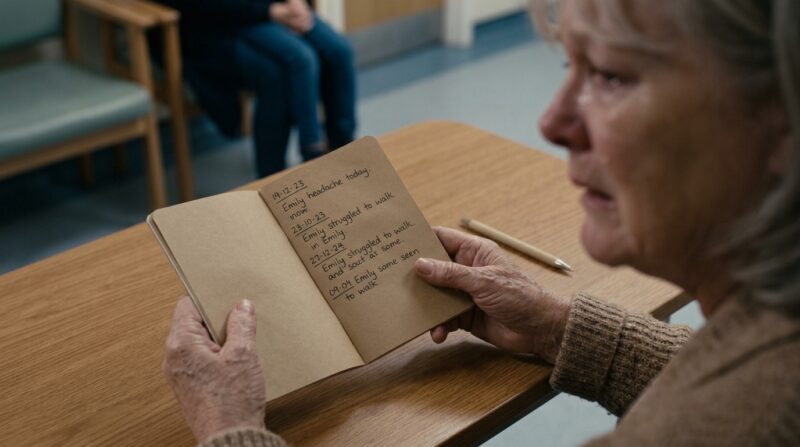
Instead, they baked cookies, planted flowers, and walked Buddy together.
One afternoon, I returned from work to find Emily reading on the couch, Buddy resting his head on her lap.
Margaret sat beside her, helping with difficult words.
Emily smiled at me.
“Mommy, Grandma says the best stories aren’t inside a phone.”
Margaret looked up, tears shining in her eyes.
I smiled back.
Forgiveness hadn’t come easily. Margaret had broken our trust, and rebuilding it took time.
But she accepted responsibility, changed her behavior, and never again ignored Emily’s concerns.
I learned that sometimes the greatest danger in a family isn’t cruelty, but silence born from fear and shame.
And Emily taught us something even more important.
A quiet child isn’t necessarily a healthy or happy child. Children need adults who truly notice, listen, and act when something seems wrong.
Today, watching Margaret laugh with her granddaughter, I’m grateful our darkest chapter ended with recovery and a second chance.
But would you forgive your mother-in-law if her silence had endangered your child’s health, or would you never trust her again? 💔